Showing posts with label grammar. Show all posts

Monday, 1 June 2015

Do does and did

This week we are using a lot of the auxiliary verb TO DO for making questions.
like 
Does he have brothers or sisters?
or
Do you have brothers and sisters?

We use DID when asking abut the past like in

Where did you go on the last summer holidays?

So let´s revise this verb with a very good teacher on Youtube. 

Friday, 22 May 2015

Modal verbs


Parte de la cultura anglosajona es la educación y las "good manners" para pedir permiso o sugerir algo.
 Para ello en inglés podemos utilizar una variedad de verbos modales, MODAL VERBS. Aquí nos vamos a centrar en tres de ellos.
SHALL
MAY
CAN
Para visualizar y recordar de forma rápida sus diferencias, funciones y ejemplos, he creado este sencillo mapa conceptual.


 Con este vídeo vemos además algunos ejemplos del uso de estos verbos en conversaciones rutinarias.


Thursday, 21 May 2015

Phrasal verbs

En tercero vamos a ver algunos "phrasal verbs". Son verbos compuestos con adverbio o preposición. Algunos "phrasal verb" tienen doble significado y se pueden utilizar en muchas situaciones.
Utilizamos muchos de ellos en clase de forma rutinaria como:

 "turn on the computer"
"turn off the lights"
"go back"
"move forward"
"calm down"
" put your hands up"


Let's practice  some games.


Tuesday, 12 May 2015

Frecuency


Para hablar de nuestras rutinas, lo que hacemos habitualmente o de forma puntual, utilizamos una serie de palabras llamadas "adverbs of frecuency". 
Aquí os proponemos un vídeo cortito para repasar algunas acciones.


Monday, 11 May 2015

Comparative adjectives


This week we are learning how to compare 2 things with the "ER" at the end of the adjective and the word THAN. For example:

Mary is taller than Peter.
To refresh some of this comparative forms here we have some short videos:


This er and than combination is used with adjectives of one or two syllables but when we have longer words like important, beautiful, etc, we must use more before the adjective.

                      more beautiful 
                         more interesting
                       more expensive

But when we want to compare more than two things, two people, etc, we must use "est" at the end of the adjective and add of. For example:

 My house is the smallest of my block.
My hair is the longest of my class.

In these videos we can see the use of both types of comparatives.


When comparing more than 2 things and with adjectives of 3 o more syllables  we use "MOST".

Wednesday, 6 May 2015

Question words.


This week we are going to practice playing with a special dice.
The dice of the Questions Words.
We are going to focus on the words:
Who
Why
What
When
Where
Which

Essential words to ask and learn new things every day.
Here I publish the dice template so you can print it, cut it, fold it and glue it.


How to play?

Con al menos dos personas. Una tira el dado y debe realizar una pregunta al otro utilizando la palabra que le ha salido por azar.
Se puede definir el tema antes de empezar el juego a ver quién sabe más de un personaje en concreto por ejemplo, Bob Esponja:
Where? Where does he live?
Who is his best friend?
Which animal is his pet?

I hope you enjoy it.

Tuesday, 21 April 2015

Irregular verbs

Ya estamos aprendiendo que hay muchos verbos irregulares en inglés y para poder expresarnos en pasado necesitamos recordar esos verbos. Poco a poco debemos ir memorizando los verbos más utilizados en conversaciones cotidianas. 
Aquí os presento un resumen del libro con 20 de esos verbos.


To practice some of these verbs let´s play these games:


Sunday, 19 April 2015

Possessive # 2

Last week we saw the possessive adjectives, like " my, his, her, your, our, their". 
This week we are going to learn a new cooler way of expressing possession or certain relationship between things.
With the genitive case, or saxon genitive:

Hasta ahora decíamos:

Pues bien a partir de ahora utilizaremos el Genitivo sajón, " Genitive case"

y diremos:


Para construir el genitivo sajón necesitamos utilizar un "apostrophe" en el nombre de la persona o cosa que tiene posesión de la palabra que le sigue.
Para ver el uso de este genitivo veamos unos vídeos:


To practice the genitive case let´s try these exercices:

picture and exercise´s source: http://www.englishexercises.org/


pictures and exercises´ source:  http://resources.hwb.wales.gov.uk/

picture and exercise´s source:http://www.autoenglish.org/

picture and exercise´s source http://www.prof2000.pt/users/tereza_n/possessive_1.htm


Tuesday, 14 April 2015

Possesive # 1

Hello all!, this week we are introducing the possessive adjectives.

Possessives tell you who it belongs to. So far we have studied the personal pronouns: I she, he, it, you ( singular and plural), we and they. 
Now we are going to use the possessive adjectives more often.


Foto extraída de la presentación
 http://www.slideshare.net/clingmur/personal-and-possessive-pronouns

On these videos we can see the possessive adjectives in use.


To practice these possessives let's play some games:


las tres imágenes superiores han sido extraídas de la página http://www.eslgamesplus.com/.

This game has been located in https://learnenglishkids.britishcouncil.org

Thursday, 9 April 2015

Present progressive


Esta semana nos metemos de lleno con el presente continuo or Present  Progessive.
Nos centramos en dos usos, por ahora:
  • Acciones que están pasando en el momento de la narración.
  • Planes seguros para el futuro cercano como el fin de semana o el verano.

Para ilustrar mejor el concepto vamos a ver unos vídeos que apoyarán la explicación con ejemplos.


Vídeos publicados por luckylightt en Youtube.


vídeo publicado por adwasakinah en Youtube.


 Vídeo publicado por Ana Dilara Martinez en Youtube.


Una vez entendido veamos si lo podemos poner en práctica con estos ejercicios. Haced click en las imágenes para practicar:
Juego publicado por  ESL games en http://www.eslgamesplus.com/

Juego publicado por  ESL games en http://www.eslgamesplus.com/

Juego publicado por Bradleys English School en http://www.bradleys-english-school.com/


Para diferenciar entre el presente simple y continuo

Juego publicado por  ESL games world  en http://eslgamesworld.com/

Algo más avanzado para los más valientes:
Actividad publicada por Mrs Haquet en http://chagall-col.spip.ac-rouen.fr/IMG/didapages/presentcont/index.html


Monday, 16 March 2015

Quantifiers


Some, many, more, little, very... son algunos adverbios que utilizamos para hablar de cantidades. Algunos los utilizamos con cosas que se pueden contar y otros con cosas incontables.
Veamos unos vídeos para repasar cómo utilizar estas palabras en inglés.


Decide contables o incontables, much or many?
Much lo utilizamos para nombres incontables y many para contables. comprueba esta idea con este ejercicio.


SOME

 We usually use some in positive sentences for countable and uncountable nouns.

MANY

It is used with negative sentence, when asking questions and when a sentence is grammatically positive, but the meaning of the sentence is negative.

Para practicar con SOME y MANY juguemos:


Ahora probamos con much, many, little.


Wednesday, 25 February 2015

Indefinite pronouns


Ya hemos visto en el pasado los pronombres más usados y comunes, los "personal pronouns" como:
I, YOU, SHE, HE, IT
WE, YOU, THEY

Pues bien ahora nos atrevemos con algunos que son más indefinidos, los que no se refieren a ciertas personas, cosas o cantidades.
ALL, ANYTHING, ANOTHER, BOTH, EACH, 
MANY, NOTHING, SOMETHING
Para entrar en calor vamos a ver estos vídeos sobre los diferentes pronombres y le agradecemos la colaboración a niña de Memory freak por la canción.


Friday, 20 February 2015

Conjunctions


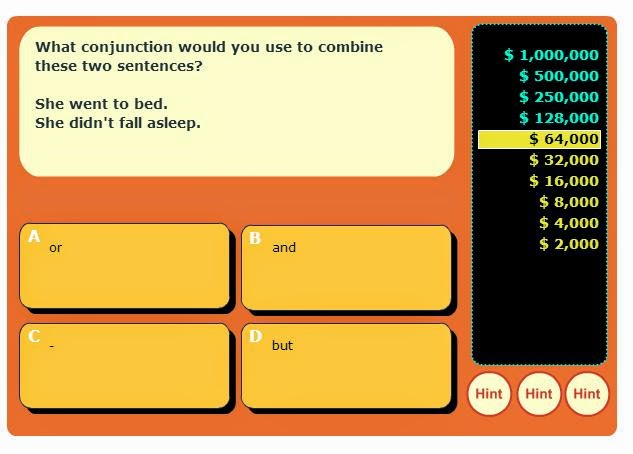
Para construir frases más completas necesitamos los conectores, las conjunciones. Pues bien nos vamos a centrar en las más simples por ahora, And, But, y OR. Esta página nos ofrece una rápida y simple visión de cómo utilizarlas.


En este vídeo nos cantan el uso de algunas conjunciones. 

Practicamos ahora un poco las conjunciones con estos juegos: